Houses out here mostly don’t burn because the fire reached them. They burn because an ember landed in something touching the house — bark mulch against the siding, dry grass under the deck, ten years of dead limbs piled against the shop wall. The fire on the ridge is a problem for the fire district. The fuel in the first thirty feet is the part you can actually do something about.
Some people get here because their insurance company sent a letter. Some get here after watching the last few Augusts. Either way the work is the same: take the fuel away from the house so a fire has less to carry.
The counties out here have started publishing what that means in plain terms, and several of them now have money to help homeowners pay for it. If you want to skip ahead, who helps pay in your county is further down the page.
What the Work Actually Involves
Nobody is going to make you do any of this. King County’s wildland-urban interface code has been suspended since 2021 pending state remapping, so there is no inspector coming, and it is the same story across the Cascades. What follows is King County’s Wildfire Ready Toolkit (PDF), published in July 2026 — the clearest short list any county around here has put out. The county says roughly 15% of King County lives in the wildland-urban interface, where houses meet forest. The list itself is the same whether your house is in Ravensdale, Graham or Cle Elum.
- The first 5 feet. Remove flammable material touching the house and replace it with non-flammable gravel. Wood fencing inside that 5 feet comes out too.
- Under the deck. Grass and weeds out from under decks, porches and stairs.
- 10 feet of air. Branches pruned back to 10 feet of clearance from structures.
- 30 feet for outbuildings. Sheds relocated at least 30 feet from the house.
- Roofs and gutters. Plant debris cleared off.
- Vents. Wire mesh screens over openings so embers cannot get in.
The last two you can do yourself on a Saturday with a ladder. The rest is what we do.
What Defensible Space Actually Means
It isn’t clear-cutting your property. Defensible space is about breaking up the fuel that lets fire climb and spread — the dense brush against the house, the low limbs and understory that act as a ladder into the tree canopy, the years of dead material built up on the ground. Handled well, your property still looks like Northwest property when we’re done. It just doesn’t hand a fire an easy path to your front door.
What We Do
- Zone 0 — clearing the first 5 feet around the house and replacing it with gravel
- Brush and overgrowth clearing around homes, shops and outbuildings
- Ladder fuel removal — low limbs and understory that carry fire upward
- Dense understory thinning
- Forestry mulching of everything we cut, so it stays on site as ground cover instead of leaving in a truck
- Blackberry and invasive vegetation removal
- Dead and downed material cleanup
- Clearing along driveways and access routes — so a fire engine can get in and you can get out
- Gravel delivery and placement
- Ongoing seasonal maintenance
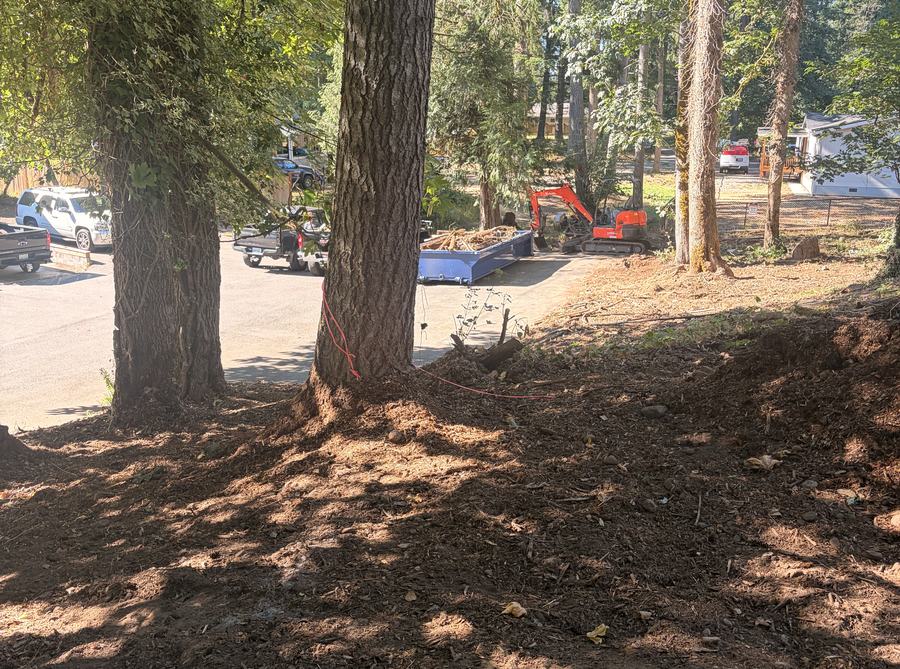
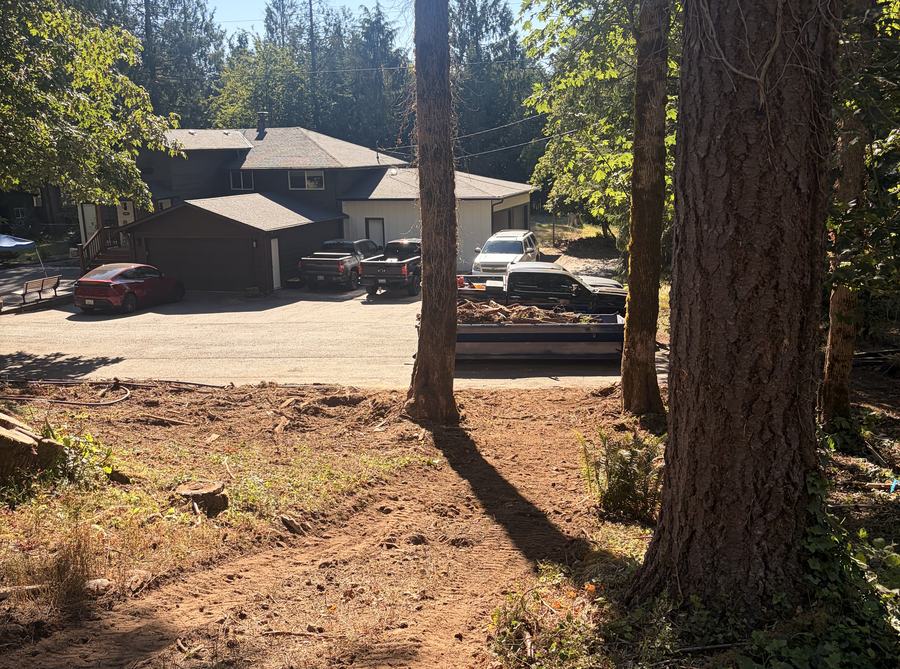
Understory and ground fuels cleared, mature trees left standing — the property opened up without being stripped bare.
The Five Feet Nobody Wants to Deal With
The hardest part of that list is the first item, because it is the strip of ground people have planted, mulched and landscaped over the years. Bark mulch against the siding is the single most flammable thing most rural homes have, and it is right where an ember lands.
Pulling it out and putting down gravel is one afternoon. We clear the vegetation and haul the gravel — same crew, same trip, no coordinating two outfits.
How We Price It
We don’t run an hourly meter and we don’t quote off a photo. We walk the property, then hand you a fixed price with the scope written down and the exclusions written down next to it. You know the number before anything starts, and it doesn’t move unless you ask it to.
What the number depends on:
- How much ground. Fifty feet around one house is a different job than five acres of understory.
- How thick it is. Ten years of blackberry is not the same as light brush, even on the same acreage.
- Whether the machine can get there. Slope, wet ground, tight quarters between buildings, and how far we have to reach from where we can park.
- Where it goes. Mulching in place is cheaper than hauling it out. When material has to leave, the number of loads and the dump are part of the job.
- Materials. Gravel or anything else brought in, quoted along with the rest of it.
Where we can’t see the whole job from the driveway, we write it as an estimate with a not-to-exceed number on it, so it can’t run away from you.
Who Helps Pay in Your County
This is the part most people don’t know about. Conservation districts in this part of Washington run wildfire programs that will send somebody out to look at your property for free, and in some counties will put money toward the work itself. It is different in every county, so here is where to start depending on where you live. We would rather you spend somebody else’s money than yours.
King County
The King Conservation District runs a wildfire mitigation program that does two things worth knowing about. They will assess your home for free — any house in the wildland-urban interface, no acreage minimum, focused on the first 100 feet around the structure. And they reimburse 75% of approved project cost for the work that comes out of it: vegetation removal, hardscaping, pruning, gutters, forest stand improvement. Reach them at 425-282-1900 or district@kingcd.org.
Two footnotes. If you are inside Eastside Fire & Rescue’s area, KCD asks you to go to the fire district for the initial assessment instead. And if you have more than an acre of forest, ask about a Forest Stewardship Plan while you have them on the phone — that is a separate and genuinely useful document.
Pierce County
Pierce has the strongest program of the three. Pierce Conservation District’s Wildfire Preparedness Grant covers 75% of total project cost, up to $4,000, and it funds the things that actually cost money: fuel reduction, chipping, tree work, home hardening, and replacing what comes out with fire-resistant planting. Labor is an eligible expense, which is unusual and is the whole point. The district can either reimburse you after the work, or pay the contractor directly and bill you for your 25%. Contact James Moore at jamesm@piercecd.org for the current application window — they run in cycles and the dates move.
Kittitas County
If you are over the pass — Cle Elum, Roslyn, Ronald, Easton, Ellensburg — the Kittitas County Conservation District does free home wildfire risk assessments, Firewise planning, and an annual cost-share program for fuels reduction. Ask for Wendy Mee, (509) 925-3352 ext 4, or wendy.mee@kccd.net. DNR’s Southeast Region also runs forest health assistance for private forestland owners; you hire your own contractor and get reimbursed.
Anywhere in Washington
The state Department of Natural Resources runs financial assistance for wildfire resilience and forest health, open to anyone owning under 5,000 forested acres in Washington. It used to be an eastern-Washington program; it now covers six regions on both sides of the crest, including South Puget Sound and Pacific Cascade. They will also come consult for free, and they will reimburse you for treatment you do yourself. If your conservation district comes up empty, this is the next call.
None of this is our money and we don’t take a cut of it. But we will happily write the scope in whatever form the district needs it, and we can schedule the work around their timeline instead of ours.
Insurance, Firewise & IBHS
If your insurer sent a letter, bring it on the property walk. We will read what they are actually asking for and talk through what it takes to get there.
If you are in a Firewise community, or working toward the IBHS Wildfire Prepared Home designation — which became available in Washington in April 2026 and combines home hardening with vegetation management — we can work to those standards too.
And if none of that applies and you just want to sleep better in August, that is reason enough.
Open, Don’t Strip
Same philosophy as everything else we do. The goal is a property that is safer and easier to defend, while keeping the mature trees, the shade and the privacy that made you want the place. We clear what needs clearing and leave the rest standing.
Where We Work
We are based in Black Diamond and work the rural stretches of King County — Enumclaw, Maple Valley, Ravensdale, Covington, Black Diamond, North Bend, Snoqualmie, Issaquah, Auburn — and Pierce County — Buckley, Bonney Lake, Orting, Graham, Eatonville, Wilkeson and Carbonado.
We also cross the pass into Kittitas County for defensible space work — Cle Elum, Roslyn, Ronald, Easton, Ellensburg. It is about an hour from the shop, the fire risk over there is a different animal, and we would rather make the drive than tell somebody no. If you are further out than that, call anyway and we will tell you straight whether the trip makes sense.