
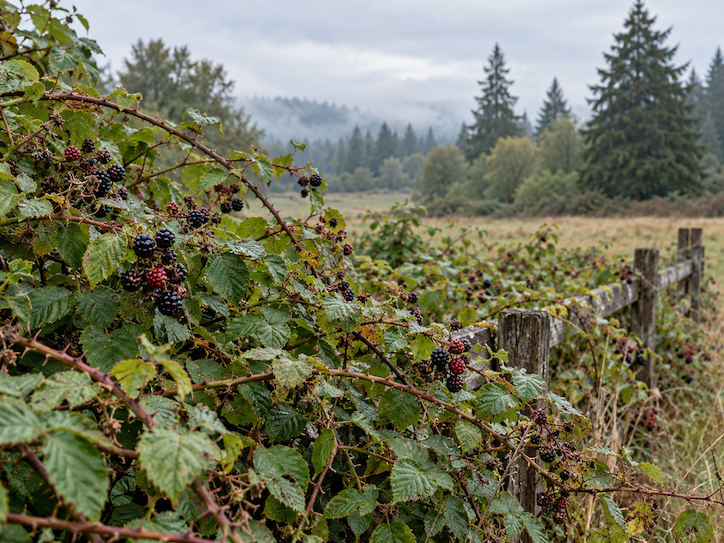
If you own acreage in King or Pierce County, you have probably stood at the edge of a blackberry thicket and wondered what would actually work. Someone mentions goats. Someone else mentions a machine. Both can clear blackberry. They do it in very different ways, on very different timelines, and with different results.
We run the machines, so we have a side. But goats are a real option, and on the right ground they are the better one. Here is how to tell which is which.
What goats do well on blackberry
Goats are browsers. They go after leaves and tender new growth, and blackberry gives them plenty of both. King County’s own noxious weed page lists livestock grazing, especially goats, among the ways to control Himalayan blackberry, alongside digging, mowing, plowing and herbicide.
That makes goats a good fit in a few situations. The first is a fenced pasture or paddock where the animals can stay put for weeks. The second is steep or rough ground where a machine would struggle. The third is a property where you are not in a hurry and want a gentle, low-noise approach.
Goats also keep working while you are at your day job. If you have the time, the fencing and a place to keep them, that counts for a lot.
Where goats fall short
The trouble is what goats leave behind. They strip the leaves and soften the thicket, but the woody stems and the root crown stay in the ground. Himalayan blackberry grows back from that crown, so a stand that looks beaten in August can be sending up canes again by the next spring.
The county is blunt about this kind of approach. Cutting or mowing the top growth only works if you repeat it, spring and fall, for several years. Grazing follows the same logic. It is a long game, not a one-time fix.
There is also the practical side. Goats need fencing, water and shelter, and they need someone to look after them. On an open hillside next to a road, or a lot with no fence, that is a big ask. And if you are clearing for a sale, a building pad or a fence line this spring, “give it a couple of seasons” is not much of a plan.
What a mulcher does differently
A forestry mulcher grinds the canes, brush and small growth into mulch right where it stands. There is no burn pile and no truck load of debris. The ground opens up in a day or two instead of a season or two, and the mulch left behind helps hold the soil.
We also work around what you want to keep. Before a machine starts, we mark the trees, the screening and anything holding a bank. Healthy timber stays standing. The thicket underneath it goes. That is the idea behind how we work: open the ground up, do not strip it bare.
We will be straight about the limits. Mulching clears the top growth fast, but blackberry can still send up shoots from the roots, so some regrowth should be expected. Where you want the ground to stay open, we can pull the root crowns after the knock-down with a mini excavator, which takes out most of what would come back. A follow-up pass the next season handles the rest. Anyone who promises one visit ends it forever has not done many of these.
Mulching in place also is not right for every site. On wet, flat ground with a heavy root load, it can be better to get the material off the dirt so it does not re-root. We price both on the property walk so you can choose.
Picking the right approach for your ground
The best answer depends on the land and what you want from it. These are the questions we would ask before recommending anything:
- How thick is it? Light canes are one job. A ten-year thicket is another.
- Is the ground fenced? Without fencing, goats are hard to use safely.
- How steep or wet is it? Slope and soft ground limit what a machine can reach.
- What is your timeline? A spring sale or build date points toward a machine.
- What is the land for? Pasture, a fence line, a building site and a walking trail each need something different.
If most of your answers point to a fenced paddock and plenty of time, goats are worth a call. If they point to open acreage, a deadline, or ground you want back for good, a machine is usually the faster and more predictable route. Some owners use both: a mulcher to knock the thicket down and pull the roots, then goats to keep the regrowth in check.
You do not have to decide from the driveway. We offer a no-cost property walk across King and Pierce Counties. We look at how far the blackberry has spread, what is worth keeping, and what the ground can handle, then give you a fixed price for the work. You can read more about how we handle blackberry and brush removal, or request a property walk or call us at 425-365-8245.